Armenia After the Vote: Democratic Legitimacy in a Fragmented South Caucasus
By Mathieu Lemoine
Armenia’s June 2026 parliamentary elections were not only a contest over government formation. It was a test of whether democratic politics can provide legitimacy for a painful post-Karabakh recalibration. Prime Minister Nikol Pashinyan’s Civil Contract party won 49.81 percent of the vote, enough to continue governing, but not the two-thirds majority required to initiate constitutional change on its own. The result strengthens Pashinyan’s mandate to pursue peace with Azerbaijan and diversify Armenia’s foreign policy, but it does not remove the structural pressures shaping the South Caucasus.
BACKGROUND:
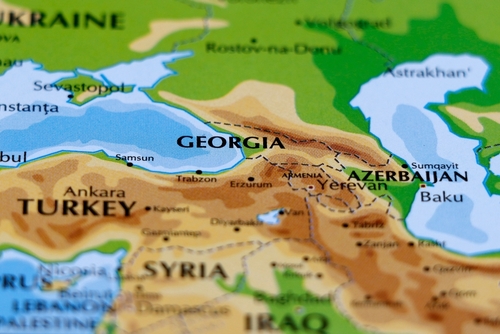
The election was Armenia’s first parliamentary vote since Azerbaijan’s 2023 takeover of Nagorno-Karabakh and the displacement of its Armenian population. It followed years of declining confidence in Russia’s security guarantees, growing Armenian engagement with the EU and the U.S., and a difficult peace process with Azerbaijan. The campaign therefore unfolded at the intersection of domestic legitimacy, post-war trauma and regional realignment.
Civil Contract’s victory confirmed that Armenian voters were not prepared to return the pre-2018 political elite to power. It also showed that Russia-oriented opposition forces, despite mobilizing dissatisfaction over Karabakh and Pashinyan’s concessions, could not convert that discontent into a governing majority. Strong Armenia received 23.29 percent of the vote, while the Armenia Alliance also remained well behind the ruling party, leaving Civil Contract with a clear lead and the ability to form a government. At the same time, the vote should not be read as a simple plebiscite on “the West.” Pashinyan campaigned on peace, sovereignty and a more balanced foreign policy, not on a clean rupture with Russia.
From an electoral perspective, the process mattered because Armenia’s foreign policy shift depends on the government’s ability to claim democratic legitimacy. International observers assessed the vote as competitive and generally well administered, while also noting a confrontational campaign environment and external pressure. Reuters also reported concerns over selective justice linked to prosecutions and arrests of opposition figures before the vote. This combination is important. The election produced a usable mandate, but not an uncontested political consensus.
IMPLICATIONS:
The first implication is that an electoral mandate is not a peace settlement. Pashinyan can now argue that voters endorsed continuity: negotiations with Azerbaijan, normalization with Türkiye and strategic diversification away from overdependence on Russia. Yet the most difficult questions remain outside the immediate reach of an ordinary parliamentary majority. Azerbaijan has demanded that Armenia amend its constitution to remove what Baku regards as an implicit reference to Nagorno-Karabakh. Pashinyan’s party did not secure the parliamentary strength needed to call a constitutional referendum on its own. This creates a gap between electoral legitimacy and constitutional capacity.
That gap will shape the next phase of negotiations. The Armenian government can continue talks, but it cannot easily present constitutional change as a purely technical step. For many Armenians, Karabakh is not only a legal issue but a national trauma. Any move perceived as closing the historical and political question of Karabakh will be vulnerable to opposition mobilization. In this sense, the election authorized a direction, but not every concession that may be required to complete it.
The second implication concerns Azerbaijan’s leverage. The vote strengthened the Armenian government domestically, but it did not alter the asymmetry created by Azerbaijan’s military advantage since 2020 and 2023. Border incidents and reports of renewed ceasefire violations, particularly around sensitive areas such as Syunik, show that negotiations continue under pressure rather than in a neutral environment. This matters because the unresolved implementation of transit arrangements, including the Trump Route for International Peace and Prosperity, leaves room for competing interpretations over sovereignty, customs, security and access between Azerbaijan proper and Nakhchivan.
Armenia can endorse connectivity as part of a peace agenda. Indeed, Pashinyan’s “Crossroads of Peace” logic depends on turning Armenia from a blockaded state into a regional connector. But if transit arrangements remain ambiguous or delayed, connectivity can also become a source of coercion. Syunik is not only a transport question. It is Armenia’s southern link to Iran, a sensitive zone in Azerbaijani-Turkish strategy, and a red line for Tehran. This is why the regional significance of Armenia’s election lies less in the result itself than in whether the government can convert its mandate into enforceable arrangements that preserve Armenian sovereignty while enabling regional trade.
The third implication is that Russia’s role is weakened but not eliminated. Moscow’s credibility as Armenia’s security patron has been severely damaged since 2020 and 2023, a reassessment reflected in Pashinyan’s own statement that Armenia’s reliance on Russia for security had been a “strategic mistake.” During the election campaign, Russian pressure appeared not only as geopolitical rhetoric but as a factor in the electoral environment: observers cited public threats and trade pressure, while media reporting also pointed to information operations aimed at influencing the vote. That is precisely why the Armenian case is instructive for the wider post-Soviet space: external influence no longer operates only through formal alliances, military bases or economic dependence. It also works through the campaign environment, information space, diaspora networks and the use of economic vulnerability.
The election showed that Russian pressure can be politically counterproductive. It did not prevent Pashinyan’s victory and may have reinforced his claim to be defending Armenian sovereignty. But Russia retains tools that can complicate Armenia’s post-election trajectory. Armenia remains economically exposed to Russia through trade, energy, labor migration and remittances. It also remains formally entangled in Russian-led institutions, even as the political basis for that alignment erodes. The region is therefore not simply becoming “post-Russian.” It is becoming less ordered, less predictable and more coercive.
The fourth implication concerns the West. The EU, the U.S. and several European states have more room to support Armenia after the election. Western political backing can strengthen Armenia’s institutional resilience, reduce isolation and support negotiations. But political support is not the same as hard security guarantees. Armenia’s strategic problem is not that it has chosen one patron over another. It is that the old patron has lost legitimacy, while no new actor is prepared to replace it as a security guarantor.
This creates a difficult policy environment for Yerevan. Armenia must deepen cooperation with Western partners without provoking expectations that cannot be met. It must maintain relations with Iran without undermining its Western outreach. It must manage Russia without returning to dependency. And it must negotiate with Azerbaijan from a weaker position while persuading Armenian society that peace is not capitulation. Elections can legitimize this course, but they cannot substitute for a security architecture.
For the South Caucasus, the broader lesson is that the regional order is moving beyond Russian-centered conflict management without yet acquiring a stable replacement. Azerbaijan is more powerful. Türkiye is more central. Iran is defensive about corridor politics and border changes. Russia is weakened but still disruptive. Western actors are more present but cautious. In this environment, Armenia’s election is regionally significant because it tested whether democratic legitimacy can support a small state’s strategic adaptation under pressure.
CONCLUSIONS:
Armenia’s election should not be interpreted only as a geopolitical choice between Russia and the West. It is better understood as a case of democratic mandate under strategic constraint. Pashinyan now has renewed legitimacy to pursue peace, normalization and diversification. Yet this legitimacy does not by itself resolve the constitutional question, Azerbaijan’s leverage, Russian coercive tools, uncertainty over transit arrangements, or the lack of enforceable Western security guarantees.
The vote therefore clarifies Armenia’s direction but not its destination. It gives the government political authority to continue, but the durability of that authority will depend on whether peace and connectivity produce tangible security rather than new vulnerabilities. If Armenia can translate electoral legitimacy into a credible settlement, stronger institutions and diversified partnerships, the 2026 election may become a turning point in the South Caucasus. If not, it may be remembered as a mandate that clarified the country’s intentions without resolving the regional pressures surrounding them.
The central lesson extends beyond Armenia. In a fragmented South Caucasus, elections can authorize strategic change, but they cannot replace security architecture. Democratic legitimacy is a necessary resource for Armenia’s post-Karabakh recalibration. It is not, on its own, a guarantee that the region will become more stable.
AUTHOR’S BIO:
Mathieu Lemoine is a governance, rule of law and public sector reform professional with experience across UNDP, USAID, OSCE, EU institutions and election observation missions. He has worked extensively on governance, elections, civil society and regional dynamics in Central Asia, Eastern Europe and the South Caucasus.
Türkiye-Armenia Border Reopening: A Turning Point For The South Caucasus
By Alpaslan Özerdem and Olesya Vartanyan
After more than three decades of closure, the Türkiye-Armenia border may soon reopen. A string of recent developments, including the launch of Turkish Airlines flights to Yerevan, agreements to simplify visa procedures, and moves toward direct land trade, suggest that normalization is shifting from cautious diplomacy toward practical implementation. If it does, it would mark one of the most consequential geopolitical shifts in the South Caucasus since the end of the Cold War. Yet reopening the border will require careful political management. Without it, renewed contact could generate friction rather than stability.
BACKGROUND:
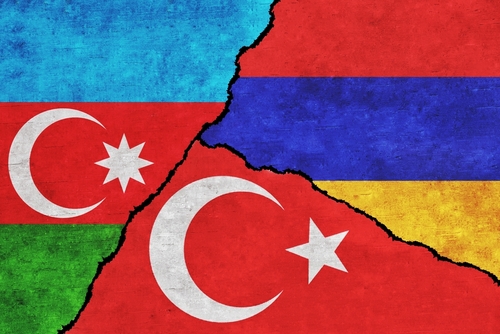
The land border between Türkiye and Armenia has been closed since 1993. Ankara shut the crossing in solidarity with Azerbaijan during the first war over Nagorno-Karabakh. Since then, the border has symbolized one of the most enduring geopolitical divides in the region. For communities on both sides, the closure produced long-term economic and social consequences. Armenia’s access to regional markets has remained constrained, while eastern Turkish border regions have also faced limited cross-border economic opportunities.
Regional dynamics began shifting after the 2020 war between Armenia and Azerbaijan, which altered the political balance in the South Caucasus and created new incentives for diplomatic engagement. In the aftermath of the war, Ankara and Yerevan appointed special envoys in 2021 to explore the possibility of restoring diplomatic relations and reopening the border.
Since then, negotiations have progressed slowly but steadily. Several confidence-building measures have been agreed and some already implemented. These include agreements allowing third-country citizens to cross the border, the resumption of direct flights between Istanbul and Yerevan, and discussions on facilitating trade and travel. In early 2026, the pace of normalization accelerated visibly. In March, Turkish Airlines launched regular scheduled flights on the Istanbul-Yerevan route. The two governments agreed to simplify visa procedures, and reports emerged that direct land trade between Türkiye and Armenia would begin as part of a broader US-led Caucasus peace push. Last December Bloomberg reported that Ankara was weighing a full reopening of the border within six months, while senior Turkish officials publicly expressed optimism, stating that they hoped “everything develops quickly.”
Physical preparations also indicate growing readiness. Armenia has renovated the Margara checkpoint on its side of the border, declaring the facility technically ready for operation. Türkiye has likewise upgraded infrastructure at the Alican crossing. These preparations suggest that the technical conditions for reopening could be met relatively quickly if political decisions align.
Still, reopening the border remains politically sensitive. For Türkiye, the process remains closely linked to the broader relationship between Armenia and Azerbaijan, particularly negotiations over a comprehensive peace agreement following the collapse of the self-declared Nagorno-Karabakh authorities in 2023. Since last August, when the two countries signed several accords at the White House, Baku and Yerevan have taken a number of steps forward, including facilitating transit trade to Armenia through Azerbaijan and Armenia’s recent agreement with the United States on the TRIPP transit route, which will facilitate the operation of a transit route between Azerbaijan and its enclave of Nakhchivan in southern Armenia. These are promising steps, but a final peace agreement is still pending, which Türkiye must take into consideration.
Ankara has long coordinated its approach toward Armenia with Baku. Turkish policymakers have repeatedly emphasized that normalization should not undermine Azerbaijan’s strategic interests, and progress in Türkiye-Armenia relations has often moved in parallel with developments in Armenia-Azerbaijan negotiations. How close are the parties to a final agreement on the border? The string of practical steps in early 2026 suggests the process has crossed a threshold from symbolic confidence-building to operational preparation. Yet the absence of a finalized Armenia-Azerbaijan peace deal means that Ankara retains a political brake on the timeline. A stall or deterioration in those talks could slow or freeze the border track; conversely, a breakthrough could accelerate it rapidly.
Domestic political considerations also matter. In Armenia, normalization with Türkiye remains controversial for segments of society deeply affected by historical grievances, and the issue will feature in the country’s upcoming June parliamentary elections. In Türkiye, policymakers must balance diplomatic engagement with Armenia against their longstanding strategic partnership with Azerbaijan.
IMPLICATIONS:
If and when the border reopens, the effects will extend well beyond bilateral relations. Armenia has long depended on limited transit routes through Georgia and Iran to access external markets. Opening the Turkish border would provide an alternative corridor, linking Armenia more directly to European and Middle Eastern trade networks. It would also reinforce Türkiye’s role as a regional connector between the South Caucasus and broader Eurasian markets. In this context, reopening the border aligns with wider connectivity initiatives such as the Middle Corridor, which aims to strengthen east-west trade routes across the region.
Russia’s influence in the South Caucasus has weakened since the start of the war in Ukraine and the collapse of its peacekeeping mission in Nagorno-Karabakh in 2023. As Moscow’s role recedes, regional actors are increasingly seeking alternative economic and diplomatic partnerships. In parallel, instability in the Middle East, including conflict involving Iran, has heightened uncertainty along key transit routes. For Armenia, which has relied on access through Iranian territory, reopening the Turkish border would reduce dependence on a single corridor and provide greater strategic flexibility.
On the other hand, the expansion of trade and transit routes associated with reopening the Türkiye-Armenia border could deepen regional interdependence and, in turn, support longer-term peace between Armenia and Azerbaijan. Durable reconciliation rarely rests on diplomatic agreements alone; it often emerges when economic cooperation and shared interests make renewed conflict increasingly costly. Expanded trade, transportation links, and cross-border mobility can help create these incentives by encouraging regional actors to view cooperation not as a concession but as mutual gain.
At the local level, decades of closure have left many towns near the frontier economically stagnant. Renewed cross-border access could stimulate transportation links, tourism, and commercial exchange. Armenian producers would gain easier access to Turkish markets, while Turkish businesses could expand trade with Armenia and potentially beyond. However, regions that have been economically isolated for decades may struggle to adjust quickly to new competitive pressures, and if cross-border trade develops unevenly, local communities could perceive the reopening as disruptive rather than beneficial.
The practical challenges of reopening should not be underestimated. Local authorities, customs agencies, border police, and regulatory bodies on both sides have never previously operated together. Communities along the frontier have lived in close geographical proximity but political separation for decades. In the Armenian village of Margara, residents have long lived within sight of the Turkish side of the river without direct contact. Renewed engagement may generate economic and cultural exchange, but it could also expose differences in administrative practices, expectations, and social attitudes that will require careful management on both sides.
CONCLUSIONS:
The reopening of the Türkiye-Armenia border represents more than a bilateral diplomatic milestone. It reflects a broader transformation in the political landscape of the South Caucasus. The rapid accumulation of practical steps in early 2026, from flights to visa agreements to land trade, indicates that the process has moved beyond the realm of aspirational diplomacy. Yet the outcome is not guaranteed. The process remains closely linked to developments in Armenia-Azerbaijan relations, domestic political considerations in both countries, and evolving regional geopolitics. Whether Ankara ultimately opens the border before or after a finalized Armenia-Azerbaijan peace deal will be a critical signal of how much Türkiye is willing to decouple the two tracks. Whether the border ultimately becomes a bridge between the two societies or simply another contested frontier will depend on how effectively these challenges are addressed not only in the coming months, but in the longer term.
AUTHOR’S BIO:
Alpaslan Özerdem is Dean of the Carter School for Peace and Conflict Resolution at George Mason University. Olesya Vartanyan is a conflict analyst specializing in South Caucasus security and peace processes and a PhD student at George Mason University.
The Fragmentation Of The South Caucasus And Its Consequences
By Stephen Blank
While Central Asian cohesion and regional cooperation grow; the South Caucasus is fragmenting. This process increasingly affects the nature and scope of regional interactions with key international actors. Russian influence has declined precipitously in Armenia, which is turning to the West, and Azerbaijan, which is expanding its circle of partners. However, in Georgia the state increasingly resembles Russia in its autocratic and legal structure and thus its state practices.
BACKGROUND:
Writing in 2024, the Azeri scholar Gulshan Pashayeva observed that a defining feature of the Caucasus was its fragmentation. This fragmentation is deepening and in effect, relationships between the South Caucasus and key external actors have quickly grown and assumed new shapes in 2025. Georgia’s dependence on Russia has grown, whereas Russian influence in Armenia and Azerbaijan has visibly declined as these states are turning to Washington and Europe.
Georgia is paying the supreme price of colonial status as it over time loses territory to Russia as both South Ossetia and Abkhazia virtually included in the Russian Federation. The Russian-driven borderization whereby Russian or pro-Russian forces either overtly or surreptitiously move border posts demarcating Russian-controlled from Georgian territories to expand Russia’s holdings occurs with impunity.
The mounting discord between the Georgian government and the EU also exemplifies Georgia’s regression. Georgia’s government, possibly at Moscow’s behest, is trampling upon processes necessary for Georgian admission into the EU and frustrating both Brussels’ conditions and the continuing support for EU membership among a majority of the Georgian population.
Armenia’s government is implementing a program of democratic reform and ultimate membership in the EU while striving to make a conclusive peace with Azerbaijan and normalize ties to Turkey despite staunch resistance by domestic, diasporic elements, the Church and Russian influencers. None of these groups supports peace and many of them, including Russia, fear democratization as signaling a decisive political defeat at home as well as a threat to Russia. It is no surprise that the Church with Russian backing emerged as the leader of an attempted coup in 2025 to replicate Russia’s success in Georgia and reverse Yerevan’s turn to the West.
Azerbaijan’s case is even more striking. Beyond its military-diplomatic success in forging an alliance with Turkey and partnership with Israel to strengthen its military capability, it neutralized Russian support for Armenia while improving ties with key European states and the U.S. The Trump Administration has now built a permanent monument to its military-economic presence in the Caucasus, namely the Trump International Road for Peace and Prosperity (TRIPP). This project brings Washington into the Caucasus as a permanent player and checks Iranian threats to Azerbaijan and links to Armenia, while giving Yerevan a tangible reward for its pro-Western and anti-Russian policies. Meanwhile, Russia’s downing of an Azerbaijani airplane in 2024 and attacks on Azerbaijani residents in Russia have generated enormous resentment in Azerbaijan.
IMPLICATIONS:
The Caucasus has become a battleground where the great powers and their favored local governments are not only on opposite sides, but where these powers’ rivalry also spills over into trade routes. The TRIPP has duly triggered Georgian apprehension since that project’s inauguration may well push aside Georgia as a preferred partner in the Middle Corridor project that ties together China, Central Asia, and ultimately Europe. But the significance of TRIPP far transcends its potential impact upon Georgia.
This project is only the latest manifestation of the declining Russian influence in the Caucasus and the parallel ensuing fragmentation of the region. While Moscow still holds many levers of influence and has no scruples about using them; they are fewer, less potent than before, and Russia faces a greater and more sustained foreign presence in the Caucasus than at any time since the disintegration of the USSR. Neither is this foreign influence strictly economic as in China’s case and as seen in its sponsorship of the Middle Corridor trade and transportation route through Azerbaijan that bypasses Russia. Türkiye’s alliance with Azerbaijan is of an explicitly military nature that provides an enduring supply of weapons, training, and presumably logistical and intelligence support for Azerbaijan. Türkiye also buttresses this support by providing the primary terminus for Azerbaijan’s increasing energy exports to Europe. Beyond these increasingly deep-rooted connections to Azerbaijan, through the Organization of Turkic States Türkiye now also has an institutional base for enduring outreach to Central Asia and the provision of all manner of military and economic ties to that region.
Azerbaijan is also increasingly tied to the Middle East through its long-running defense and economic ties to Israel, their mutual collaboration against Iran and its membership in both the Abraham Accords and President Trump’s Board of Peace. Likewise, the EU and Azerbaijan have embarked upon a mutually rewarding series of ties independent of Russian influence and also primarily based on Azerbaijani energy exports in return for EU investment and political support.
Moreover, the advent of the TRIPP has launched what looks like a sustained U.S. presence in the Caucasus. This project is taking physical shape and Vice-President Vance’s visit to Armenia and Azerbaijan demonstrates that sustained interest. Under this project, “American companies could develop railways, roads, and pipelines linking Azerbaijan proper to its Nakhchivan exclave via a corridor through the south of Armenia’s Syunik Province.” Since Azerbaijan is now providing Armenia with energy, a formal peace treaty terminating the state of war over Nagorno-Karabakh under U.S. auspices seems likely. Beyond those signs of U.S. influence, President Trump has just stated that Vance’s tour will, “strengthen our strategic partnership with Azerbaijan, a beautiful Agreement for Peaceful Nuclear Cooperation with Armenia, Deals for our Great Semiconductor Makers, and the sale of Made in the U.S.A. Defense Equipment, such as body armor and boats, and more, to Azerbaijan.” If this lasting multi-domain U.S. presence materializes, it will represent a major blow to Russian ambitions but also codify the fragmentation of the Caucasus and exclude Georgia from the growing and long-term international competition in the region for a long time to come.
CONCLUSIONS:
Russia certainly still has cards to play. It has a long-term military base at Gyumri, Armenia, and well-established connections among the Armenian opposition that is both unreconciled to the loss of Nagorno-Karabakh and to the Pashinyan government’s democratizing reforms and efforts to join the EU. Russia also has substantial economic connections to Georgia and what looks like a secure base of influence in Georgia’s government.
Nevertheless, it is a declining power economically if not militarily and cannot stop the rising foreign presence in the Caucasus. Indeed, it depends on trade coming from Armenia and Central Assia to circumvent Western sanctions and access vital Western goods. Iran, whose back is to the wall due to combined U.S., Israeli, and European military-economic pressure, cannot bail it out. Nor will China, the primary sponsor of the Middle Corridor, rescue it in the Caucasus. Despite the Russo-Chinese “no-limits” partnership, Beijing has never lifted a finger to allow Russia to become a viable economic competitor across Eurasia or regarding inter-continental trade, transport, and connectivity issues.
Therefore, the fragmentation of the South Caucasus and the heightened presence of competing major international actors is likely to continue. Central Asian states, in contrast, forge ahead with mounting cohesion and collaboration. Indeed, those states, recognizing Azerbaijan’s critical geographic position and rising heft, have now included it in what used to be the 5+1 relationship with Washington, transforming it into a 6+1 formation. This development will also contribute to regional fragmentation. Azerbaijan is increasingly a power whose perspectives must embrace Washington, Europe, the Middle East, and Central Asia, not just the Caucasus.
The ethnopolitical rivalries that made the Caucasus a zone of conflict for a generation after 1991 may, however, be coming to an end as the new ties between Baku and Yerevan and greater foreign connections show. To the extent that Georgia can be helped to resolve its ethnic and other domestic cleavages that Russia continues to exploit, it may become possible for the South Caucasus to emulate the discernible regional cooperation now appearing in Central Asia.
That outcome would be to the benefit of the entire Caucasus as well as to its neighbors and interlocutors. While disappointing to Moscow, its regional clients and those “dead-enders” who wish to rekindle the fires of ethnic conflict, that way has been tried and founds wanting in the balance.
AUTHOR’S BIO:
Stephen Blank is a Senior Fellow with the Foreign Policy Research Institute (www.fpri.org.)
Learning From Central Asia: Regionalization Prospects In The South Caucasus
By Eldaniz Gusseinov & Sardor Allayarov,
Following the conclusion of a peace treaty between Azerbaijan and Armenia, three key trends are likely to shape the South Caucasus within broader global geoeconomic processes. Peace between Armenia and Azerbaijan may facilitate the emergence of the South Caucasus as a more integrated regional entity, rather than three distinct states occupying a shared geographic space. The region’s future can be understood through three interrelated dynamics: the expansion of overland infrastructure, intensified competition for markets, and increasing complexity in its geoeconomic architecture.
BACKGROUND:
An initialed peace agreement between Armenia and Azerbaijan, which was announced on August 8, 2025, under U.S. mediation, formally ended the protracted conflict and aimed to normalize bilateral relations. Despite sharing a common geographic space, the South Caucasus states differ markedly in their political, economic, and security orientations, which has historically constrained regional integration. Armenia is a member of the Eurasian Economic Union (EAEU) and the Collective Security Treaty Organization (CSTO) while simultaneously expressing aspirations for EU membership. Georgia has maintained a broadly pro-Western orientation, though less pronounced than in the past, whereas Azerbaijan prioritizes integration within the Organization of Turkic States. At the same time, both Armenia and Azerbaijan have expressed interest in joining the SCO. Additionally, Azerbaijan has attained permanent status among the consultative meetings of the Central Asian heads of states.
Similar processes can be observed in Central Asia, where the resolution of several border disputes enabled intensified cooperation through the integration of transport routes and energy hubs. Comparable developments may emerge in the South Caucasus, as border openings are likely to necessitate infrastructure expansion, followed by the harmonization of tariffs and customs procedures.
IMPLICATIONS:
At the initial stage, the institutionalization of meeting formats among South Caucasus leaders is likely to occur, both within a trilateral framework and through a 3+3 format involving other key regional actors. The Central Asia–South Caucasus format also appears promising, as the two regions are increasingly interconnected through the development of transport corridors.
The first trend is the growing demand for overland transport corridors driven by increased tensions between China and the U.S. Following significant progress in the normalization of Armenian–Azerbaijani relations, the South Caucasus, together with Central Asia, is likely to be perceived by Beijing as a relatively stable region for investment. In Central Asia, the development of overland routes is already well advanced. Kazakhstan, for example, has launched the second track of the 836-km Dostyk–Moyinty railway, increasing capacity fivefold to 60 pairs of trains per day. With a cost of nearly US$ 1 billion, it is the largest railway project undertaken since independence and a key enhancement of China–Europe transport connectivity.
However, China’s westward transport expansion through Central Asia and the South Caucasus will also underscore the need for enhanced security cooperation. In this context, Beijing may seek deeper engagement within the SCO, potentially conflicting with Georgia’s and Armenia’s aspirations to strengthen cooperation with NATO and with Azerbaijan’s efforts to advance the military dimension of integration within the Organization of Turkic States.
Kazakhstan became the second country after Russia to utilize the opening of transit routes to Armenia via Azerbaijan. The new corridor (Kazakhstan/Russia–Azerbaijan–Georgia–Armenia) reduces logistics costs and enables regular deliveries, with Kazakhstan planning to transport up to 20,000 tons of grain per month.
In parallel, construction of the China–Kyrgyzstan–Uzbekistan railway is advancing rapidly. These dynamics are likely to extend to the South Caucasus as China and the EU seek to expand overland connectivity to facilitate trade and access stable markets. This process will further link Central Asia and the South Caucasus and will require enhanced coordination to improve connectivity among major economic centers, giving rise to a second trend: the increasing complexity of the region’s geoeconomic architecture.
Despite these developments, the South Caucasus continues to consist of three states sharing a common geographic space but pursuing distinct foreign policy orientations. A comparable situation previously existed in Central Asia and did not prevent regional consolidation, as multiple institutional platforms were leveraged to advance regional interests. Similarly, the EAEU can support trade with Russia, the SCO can provide additional security frameworks for transport corridors, and both the EU and China can serve as key financiers of transport infrastructure.
The third and most significant trend is that the opening of transport links in the South Caucasus will further liberalize the market and intensify competition. For Armenia, this is likely to result in more active competition between Russian and European food producers. Modeling-based studies suggest that Russia’s effective market share will decline as Armenia’s borders open, with Europe and Turkey gaining ground. The central challenge will be to maximize the benefits of this competition by creating conditions that allow actors who compete bilaterally to nonetheless engage in trade and pursue joint projects within the South Caucasus.
Armenia’s largest solar power plant, Masrik-1, with a capacity of 62 MW, was developed by FRV and commissioned in June 2025 in the Gegharkunik region, supplying clean energy to more than 21,000 households. The project was financed with support from international banks and an EU grant, while the main construction works were carried out by the Chinese state-owned corporation CMEC. This project represents one of the clearest regional examples of cooperation among competing powers and may serve as a model for other South Caucasus states.
CONCLUSIONS:
In sum, the peace treaty between Azerbaijan and Armenia constitutes a critical turning point for the South Caucasus, positioning the region as an increasingly important transit and connectivity hub linking Central Asia, Europe, and East Asia. The region’s future trajectory will be shaped by its capacity to manage a more complex geoeconomic architecture involving multiple external actors with overlapping interests. Divergent foreign policy orientations among regional states may create opportunities to leverage a wide range of institutional platforms and investment sources. Ultimately, the impact of the peace agreement will depend on whether the regional states can translate improved connectivity and heightened competition into cooperative economic projects. The long-term success of the regionalization process will therefore hinge on the ability of regional states to manage diversity in external partnerships by preventing geopolitical competition from obstructing economic cooperation. If effectively managed, the South Caucasus can move beyond a legacy of protracted conflict and emerge as a stable, competitive, and strategically significant component of broader Eurasian geoeconomic processes.
AUTHOR’S BIO:
Eldaniz Gusseinov is a Head of Research and сo-founder at the political foresight agency Nightingale Int. and a non-resident research fellow at Haydar Aliyev Center for Eurasian Studies of the Ibn Haldun University, Istanbul.
Sardor Allayarov is an International relations expert with a research focus on theories of international relations, international order, China, Eurasia, and foreign policy. He currently serves as a Research Assistant at Urgench State University in Uzbekistan.
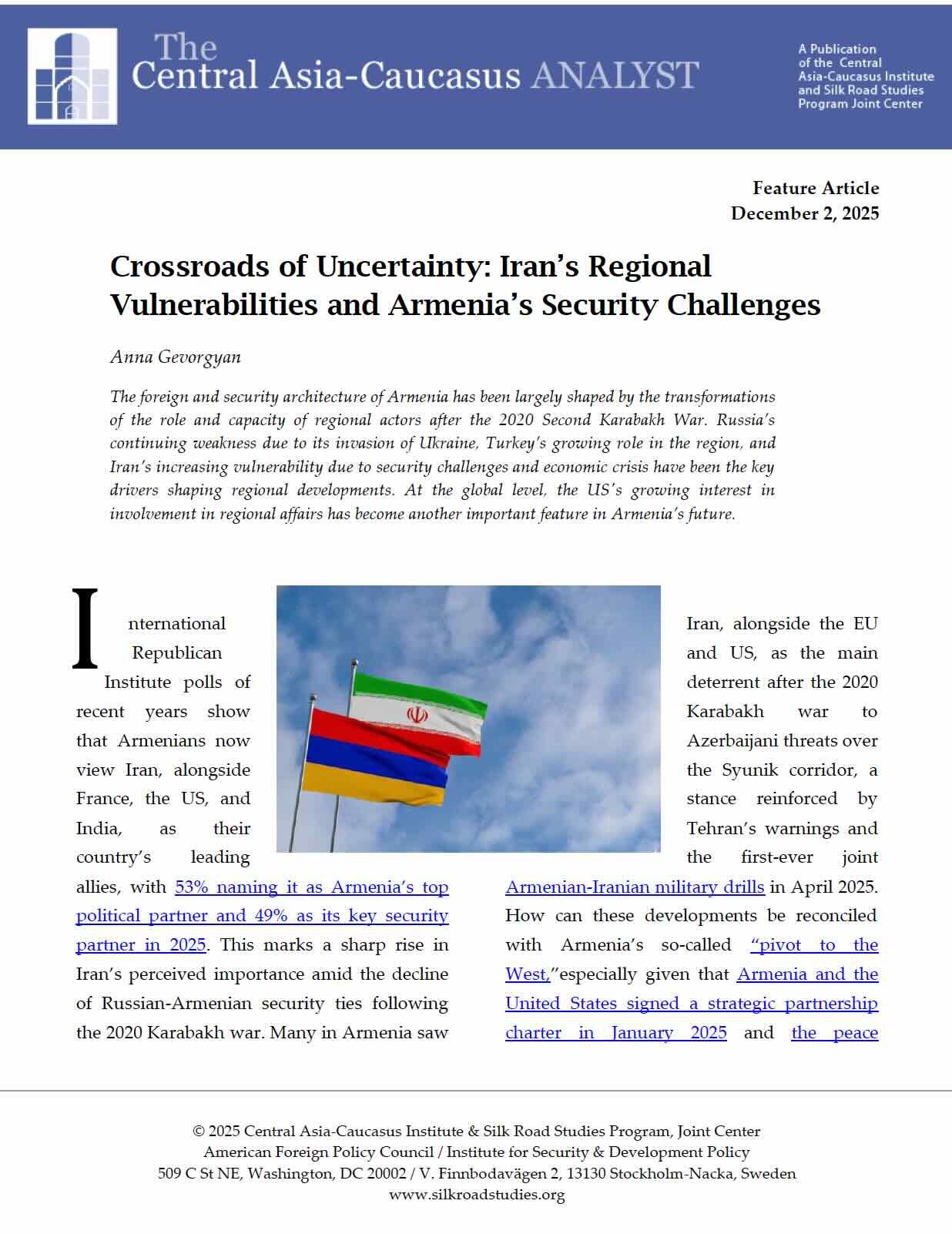
Crossroads of Uncertainty: Iran’s Regional Vulnerabilities and Armenia’s Security Challenges
By Anna Gevorgyan
The foreign and security architecture of Armenia has been largely shaped by the transformations of the role and capacity of regional actors after the 2020 Second Karabakh War. Russia’s continuing weakness due to its invasion of Ukraine, Turkey’s growing role in the region, and Iran’s increasing vulnerability due to security challenges and economic crisis have been the key drivers shaping regional developments. At the global level, the US's growing interest in involvement in regional affairs has become another important feature in Armenia’s future.
Read Crossroads of Uncertainty
Visit also